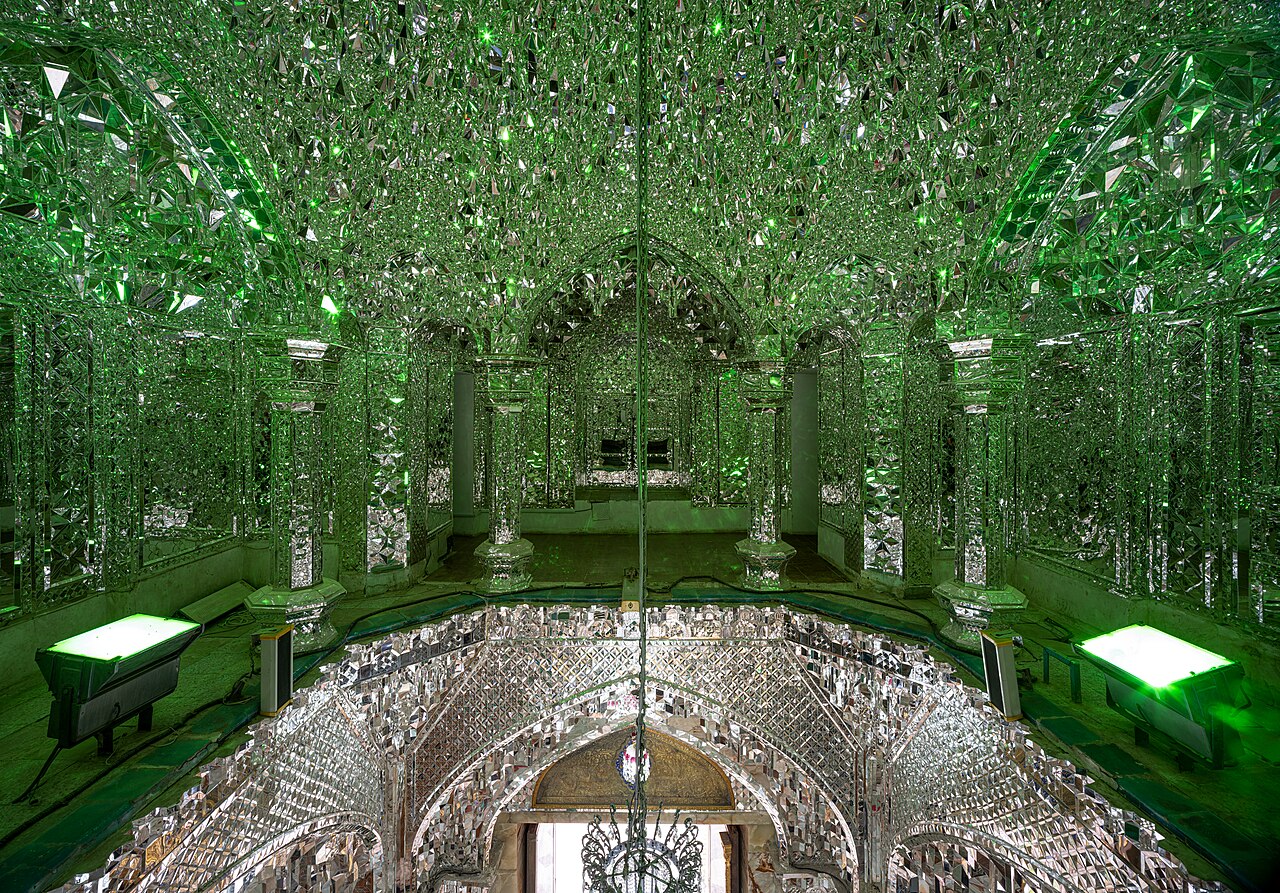
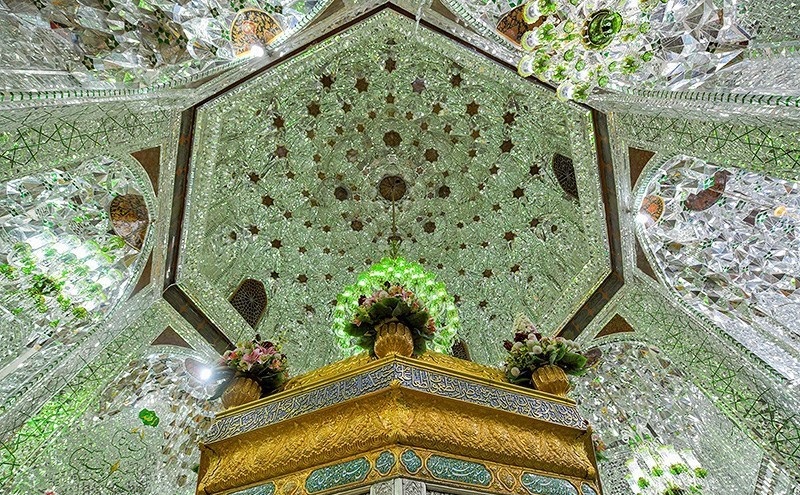
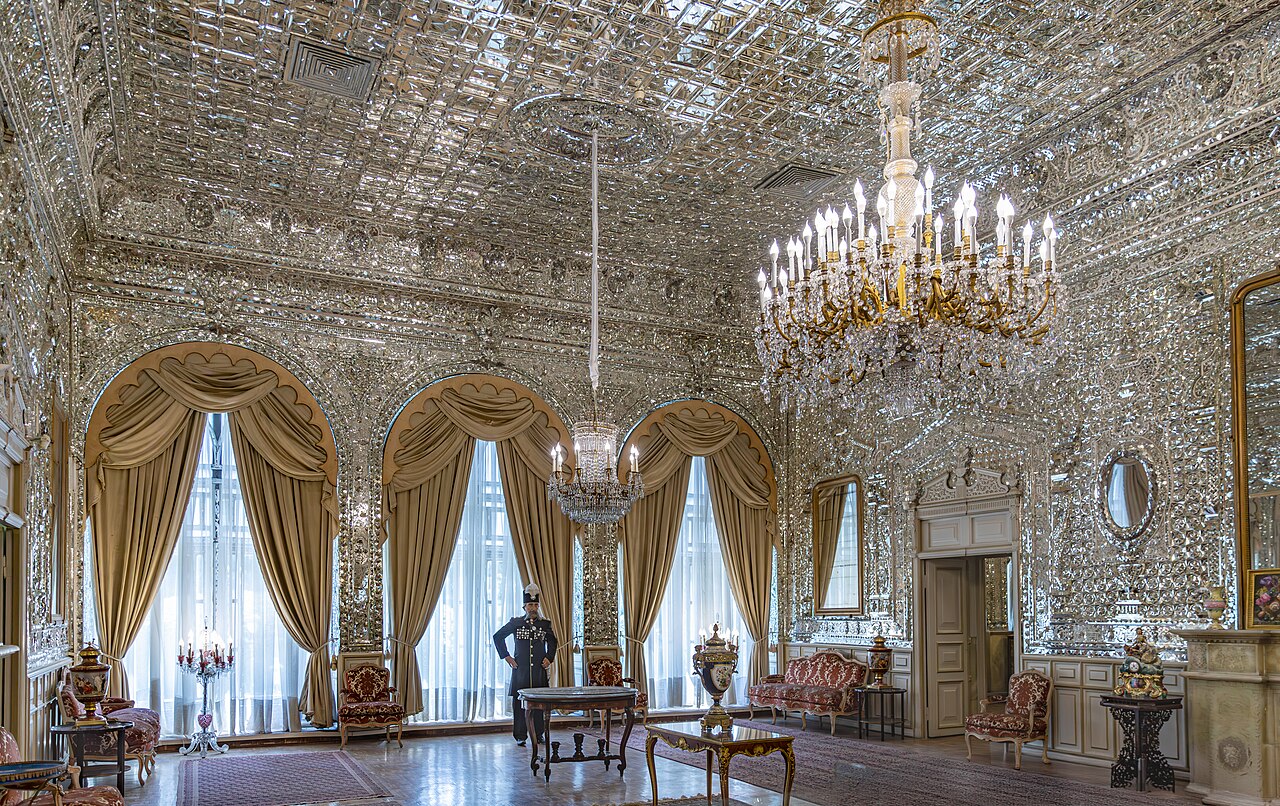
During my military service in Tehran, an unfamiliar impulse would occasionally draw me to Rey and the Shah Abdol-Azim Shrine. I had no religious affiliation. More than twenty years later, the most vivid memory of those visits is the moment of entering and becoming immersed in waves of reflection and the brilliance of the mirrorwork.
I moved through the space like a swimmer. I touched the mirrorworked walls and felt the coolness and relief of their surfaces beneath my fingers. Religious pilgrims might touch the shrine’s walls to seek a blessing. I touched them for the sensory pleasure of the surfaces themselves. For nearly half an hour, my head tilted upward and my heart pounding, I wandered in different directions. At times I sat in a corner and stared at the patterns beyond reach and the space beneath the dome.
At the time, I could not identify what kept bringing me there. I probably imagined that I had simply found a way to pass my free time. I can now trace the effect of the mirrorwork in the way I see and in the relation I have developed with the mirror.
If I were to name that condition today, I would call it wonder. The experience exceeded the contemplation of a magnificent space and astonishment at the glitter of mirrors. Its seemingly endless multiplicity destabilised my familiar image of myself and the relation between my body and the surrounding space. How can mirrorwork draw the gaze and the body so deeply into itself and bring them into a state of wonder? This essay locates that wonder in the destabilisation of the viewer’s position. The space distributes the viewer’s image among light, surface, and architecture.
Persian poetry has long joined the mirror with wonder. Their conjunction reaches a particularly condensed form in Bidel Dehlavi’s phrase “the mirror of wonder.” Returning to this history opens a field of visual imagination in which the mirror becomes a surface of appearance, concealment, multiplication, and transformation. The present essay treats the relation between poetry and mirrorwork as interpretive. It makes no historical claim that mirrorwork arose to represent these poems or realise a mystical doctrine. Poetry provides a language for seeing the material and perceptual qualities of mirrorwork more precisely.
The Mirror of Wonder
Bidel Dehlavi, Ghazal 2626:
بوی وصلی هست در رنگ بهار آینه
میگدازم دل که گردم آبیار آینه
نیست ممکن حسرت دیدار پنهان داشتن
برملا افکند جوهر خارخار آینه
کیست تا فهمد زبان بیدماغیهای من
نشئهٔ دیدار میخواهد غبار آینه
غفلت دل پردهساز تغافلهای اوست
جلوه خوابیدهست یکسر در غبار آینه
بسکه محو جلوهٔ او گشت سر تا پای من
حیرتم عکس است اگر گردم دچار آینه
نور دل خواهی به فکر ظاهرآرایی مباش
جوش زنگار است و بس نقشونگار آینه
عرض جوهر نیست غیر از زحمت روشندلان
موی چشم آرد برون خط بر غبار آینه
حسن اگر از شوخی نظاره دارد انفعال
بینگاهی میتواند کرد کار آینه
شوخی اوضاع امکان حیرت اندر حیرت است
چند باید بودنت آیینهدار آینه
عرصهٔ جولان آگاهی ندارد گرد غیر
هم به روی خویش میتازد سوار آینه
در مراد آب و رنگ از ما تحیر میخرند
بر کف دست است جنس اعتبار آینه
غیر حیرتخانهٔ دل مرکز آرام نیست
چون نفس غافل مباشید از حصار آینه
انتظاری نیست بیدل دولت جاوید وصل
حسرتم تا چند پردازد کنار آینه
A hint of union lingers in the springtime glow of the mirror;
I melt my heart, that I may water the mirror.
No longing for the sight of the beloved can remain concealed;
its fine lines lay bare the restless yearning of the mirror.
Who could understand the language of my desolation?
The dust thirsts for the rapture of beholding upon the mirror.
The heart’s heedlessness weaves the veil of his feigned indifference;
all radiance lies asleep beneath the dust of the mirror.
So utterly has my whole being vanished into his radiance
that wonder itself would be my reflection, should I come before the mirror.
If you seek the light of the heart, do not busy yourself with outward adornment;
every pattern and ornament is only tarnish surging across the mirror.
For the clear-hearted, revealing one’s inner substance is only a burden;
even an eyelash draws a line through the dust upon the mirror.
If beauty is unsettled by the boldness of being watched,
a gaze withheld can do the work of the mirror.
The restless play of contingent existence is wonder upon wonder;
how long must you hold up a mirror before the mirror?
No trace of otherness enters the field where awareness roams;
across its own face alone gallops the rider on the mirror.
For the colour and lustre they desire, they purchase wonder from us;
the proof of its worth lies openly in the palm of the mirror.
There is no resting place but the heart’s house of wonder;
like breath, do not remain unaware of the bounds of the mirror.
Bidel, there is no hope of the everlasting fortune of union;
how long must my longing keep adorning the edge of the mirror?
This discussion follows the visual system that binds the ghazal together. Each couplet contributes to that larger system. Here, the mirror acts as a material and mutable surface. Dust settles upon it, tarnish erupts from it, lines and substance appear on it, and the image alternately emerges and disappears within it. Seeing becomes a material and unstable event. Every revelation remains vulnerable to concealment and transformation.
The ghazal begins with a “hint of union” and ends with the absence of its everlasting fulfilment. The mirror makes proximity and encounter possible while every image remains provisional. Three phrases—“wonder upon wonder,” “a mirror before the mirror,” and “the bounds of the mirror”—bring this condition into view. They describe the continuation of seeing from one reflection to another, the recursive relation between viewer and mirror, and the viewer’s enclosure within a reflective space.
In another ghazal, Bidel gives a different expression to the same vision:
حسنی که یادش آینهٔ حیرت آب داد
زان رنگ جلوه کرد که داد نقاب داد
یک جلوه داشت عاشق و معشوق پیش از این
خون گردد امتیاز که عرض حجاب داد
The beauty whose remembrance gave lustre to the mirror of wonder
appeared in the very colour bestowed by the veil.
Lover and beloved once shared a single appearance;
let distinction turn to blood, for it presented the veil.
In these lines, “one appearance” and “distinction” exist at the same time. Their tension produces wonder. Lover and beloved remain two distinct forms whose shared appearance unsettles the certainty of their separation.
The conclusion of Attar’s Conference of the Birds reveals the same structure in the relation between part and whole:
در تحیر جمله سرگردان شدند
باز از نوعی دگر حیران شدند
خویش را دیدند سیمرغ تمام
بود خود سیمرغ سی مرغ مدام
بیزفان آمد از آن حضرت خطاب
کآینهست این حضرت چون آفتاب
هر که آید خویشتن بیند درو
جان و تن هم جان و تن بیند درو
چون شما سی مرغ اینجا آمدید
سی درین آیینه پیدا آمدید
گر چل و پنجاه مرغ آیید باز
پردهای از خویش بگشایید باز
In bewilderment, all became lost;
then, in another way, they wondered anew.
They saw themselves as the complete Simorgh;
the Simorgh had always been the thirty birds themselves.
Wordlessly, an address came from that presence:
this court, like the sun, is a mirror.
Whoever comes sees themselves within it;
body and soul see there both body and soul.
Since you came here as thirty birds,
thirty appeared within this mirror.
Should forty or fifty birds return,
you would lift another veil from yourselves.
The birds retain their number and difference. Thirty birds remain thirty forms, and a change in their number changes what appears in the mirror. Their apparent independence from the whole collapses. Unity emerges through the presence of these distinct forms and their relations to one another.
Mirrorwork and the Multiplicity of Reflection
An ordinary mirror generally returns a relatively coherent and bounded image of the viewer. A person stands before the surface, finds their place near the centre of the image, and distinguishes their face from the surrounding space. The boundaries between viewer, mirror surface, and image remain largely clear.
Mirrorwork disrupts this convention. The reflective surface becomes an arrangement of cut fragments extending across walls, arches, and domes. Depending on its size, shape, position, and angle upon the surface, each fragment reflects a different portion of light, architecture, the viewer’s body, surrounding objects, or the presence of others. Together, these reflections form a changing field of images generated from different angles.
Geometry structures the visual event. The cuts and placement of the fragments organise the direction and distribution of reflections and set the gaze in motion across the surface. The eye moves from a bright edge to a dark fragment, from the reflection of a face to the extension of an arch, and from there to a glimmer on the surface of a dome. As the viewer changes position, some images disappear and others replace them. The image arises from a changing relation among mirror, light, architecture, and body.
No fragment possesses the whole image, and no viewpoint can stabilise the ensemble permanently. Each reflection takes shape beside other reflections and acquires its quality from that adjacency. Mirrorwork continually recomposes the image through the relations among its many small mirrors.
Within such a structure, the image of holding “a mirror before the mirror” offers a way to read the relation between the viewer and the mirrorworked surface. Each movement places another image before the viewer and postpones access to a final view. “Wonder upon wonder” names this continuation of seeing: the gaze passes from one reflection to another, each time discovering a new relation among the elements of space.
The cuts and fragments give unity a relational form. The mirrorworked surface disrupts the viewer’s coherent image and distributes their presence among surfaces, light, and the extensions of architecture. The geometry of the cuts, the adjacency of the pieces, and their continuation across the architectural ground hold the different reflections within a shared structure. Unity takes form through the relations among the fragments.
The viewer participates in producing what they see. A step, a turn of the head, or a movement of the hand changes the arrangement of reflections. Every movement transforms part of the observed image and places the viewer within its formation. Mirrorwork turns the perception of space into an event shaped by movement.
From this perspective, another couplet approaches the experience of mirrorwork:
بسکه محو جلوهٔ او گشت سر تا پای من
حیرتم عکس است اگر گردم دچار آینه
So utterly has my whole being vanished into his radiance
that wonder itself would be my reflection, should I come before the mirror.
In relation to mirrorwork, “wonder itself would be my reflection” describes the viewer’s unsettled form among reflections. Wonder takes shape as the viewer struggles to separate their own image from the ensemble of light, surface, and architecture.
The Body within the Bounds of the Mirror
The experience of mirrorwork engages the whole body. Mirrors extend from walls to arches and the interior of a dome, forming a reflective environment around the viewer. To see this environment, the viewer raises their head, continually changes the direction of their gaze, and moves through the space. Architecture forms part of the reflective mechanism: the curve and height of the dome, the extension of the arches, and changes in the direction of surfaces shape the direction of light and the path of the gaze.
“The bounds of the mirror” can name such a space. A conventional enclosure separates inside from outside. An enclosure of mirrors returns every direction to the field of vision. The surrounding reflections prevent the viewer from finding a fixed boundary for the space or a final image of their own position. Wherever they look, part of the architecture and part of their own presence appear in a new configuration.
In my experience, touching the mirrors continued this encounter. The gaze failed to gather the multiplicity of reflections into a single image, and the hand reached toward the surface. The coolness of the glass, the borders between fragments, and the relief of the patterns gave the mirror a material presence. Touch remained local: the fingers sensed a small area while the gaze continued to move among surfaces and reflections.
Perhaps this is where my feeling of swimming came from. In swimming, an environment touches the body on every side, and every movement alters the surrounding condition. A mirrorworked space similarly blurs the boundary between observing a space and inhabiting it. I moved through a field that fragmented and multiplied my image and mingled it with light and architecture.
Wonder and Perception
More than twenty years later, I can identify the source of that attraction. The instability of my position within the image drew me there. My face and body were dispersed among thousands of fragments, the brilliance of light, the extension of the dome, and the movement of others. Running my hand across the mirrors became an attempt to touch a space that exceeded the reach of vision.
I lacked a language for the experience at the time. My body registered it through a pounding heart, a head tilted upward, wandering in different directions, and the coolness of the walls beneath my hand. Bidel’s phrase now allows me to read that moment as a condition of “wonder upon wonder.” Each reflection passed me to another reflection, and every effort to locate myself disclosed a new relation between my body and the space as a whole.
In this reading, mirrorwork presents unity as an unstable perceptual experience. The viewer enters a continuum of surface, light, architecture, and the presence of others. The self persists within this ensemble and loses the fiction of an independent position outside it. Unity emerges through the organisation of multiplicity across the surface and through the viewer’s changing experience. It unfolds within “wonder upon wonder.”