You are a luminous mirror; beware the sufferer’s sigh—
Saadi · Qasida 50
My dear, for a sigh leaves its mark upon the mirror.
In 2025, “Ayeneh-Kari, the Art of Mirror-Work in Persian Architecture” was inscribed for Iran on UNESCO’s Representative List of the Intangible Cultural Heritage of Humanity. Beyond its importance for safeguarding, the inscription underscores something repeatedly overlooked in international presentations of mirrorwork: this craft has a specific history, geography, name, and community of bearers.
That same year, the 26th Sharjah Islamic Arts Festival was held under the theme Lantern (Siraj). In the festival’s official programme, Aref Montazeri’s exhibition Reflections of Pattern was presented at the Sharjah Art Museum. Iran appeared alongside the artist’s name, yet mirrorwork was not identified as an Iranian craft with a distinct history and lineage of transmission. A report on the festival also described the mirror in his work as a “memory bank,” recording the passage of time layer by layer.
This essay is not concerned with the legitimacy of an artist’s or artwork’s presence in that festival. Sharjah is only one example of a broader tendency in which arts, techniques, and craft traditions belonging to different geographies and histories—in this case, specifically Iran—are assembled and reidentified under the encompassing name “Islamic art.” The question is this: when an artwork speaks of memory, while its classification marginalises the history of the craft on which it draws, what does that memory record—and what does it forget?
The Name of a Field or the Identity of an Art?
In academic and museum discourse, the term Islamic art does not usually refer only to religious art or to works with Islamic subject matter. It encompasses a vast range of works produced from the seventh century onwards in territories where Islam was the dominant religion or the religion of those in power. Courtly objects, textiles, vessels, illustrated manuscripts, domestic architecture, and other works without a religious function or content are therefore also placed within this field.
But this broad definition does not resolve the problem; it is the problem. Why should the dominant religion or political structure of a period become the overarching name for a collection of arts and skills, each with its own lineage, geography, materials, techniques, and trajectory of development?
The continuation of an art during the Islamic period, its development during that period, or the survival of a greater number of examples from it does not in itself alter the art’s historical origin. Many visual languages, motifs, materials, and methods of making in Iran, Central Asia, Anatolia, North Africa, and elsewhere existed before the establishment of Islamic rule and subsequently continued or changed in response to new conditions. Placing all these trajectories beneath a single religious designation obscures the distinctions among continuity, adoption, transformation, and emergence.
This ambiguity has not been criticised only from outside the field. Historians of Islamic art have repeatedly addressed the difficulty and instability of the term itself. Avinoam Shalem shows that the word “Islamic,” despite its explicit reference to a religion, is made in academic usage to encompass the entire cultural expanse of Muslim societies. Oleg Grabar, illustrating the heterogeneity of this grouping, observes that the relationship between vastly different works in the “Islamic world” is not necessarily greater than that between the Palace of Versailles and a Russian icon in the “Christian world.”
We do not ordinarily call all European painting, architecture, metalwork, textiles, and other arts produced during centuries of Christian rule simply “Christian art.” We distinguish among Roman, Byzantine, Italian, Flemish, French, Gothic, Renaissance, Baroque, courtly, domestic, and religious traditions. “Christian” is a more precise designation when a work’s content, function, commission, or worldview has a clear relation to Christianity. Yet across the vast geography extending from Spain to Central Asia and India, a religious label often displaces a constellation of historical, regional, and cultural names.
Religious Art and Religious Context
There is a distinction between “religious art” and art produced in a society with a particular dominant religion. A Christian icon, an altarpiece, or a pictorial account of a biblical narrative is connected to its religious tradition through its subject, function, and place of use. A Tibetan thangka is likewise commonly made for meditation, instruction, or ritual, depicting Buddhas and bodhisattvas according to Buddhist narrative and ceremonial traditions. In such examples, religion is not merely the historical setting in which the work was produced; it is directly present in its content, function, and reception.
Within Islamic art, too, a Qur’an manuscript, a mihrab, elements connected to mosque rituals, or a work that specifically articulates religious narratives and concepts can be understood more clearly as religious art. But this relationship cannot be extended to every work made in a Muslim society without examining its content and function.
The argument is not that the term “Islamic art” must be removed from every exhibition or study. Iranian mirrorwork can appear in an exhibition about the arts of the Islamic world, light, geometry, architecture, heritage, or contemporary art. Each of these titles can offer a particular angle from which to view the work. The problem begins when an interpretive frame becomes the work’s sole identity—when “Islamic art” takes the place of the name Iranian mirrorwork, its history of formation, its community of master artisans, and the diversity of its uses. At that point, classification is no longer merely interpretive; it is imposed.
Origin, Use, and the Frame of Display
To avoid this conflation, three levels must be distinguished: the origin of a craft tradition, its historical uses, and the frame chosen for its presentation today.
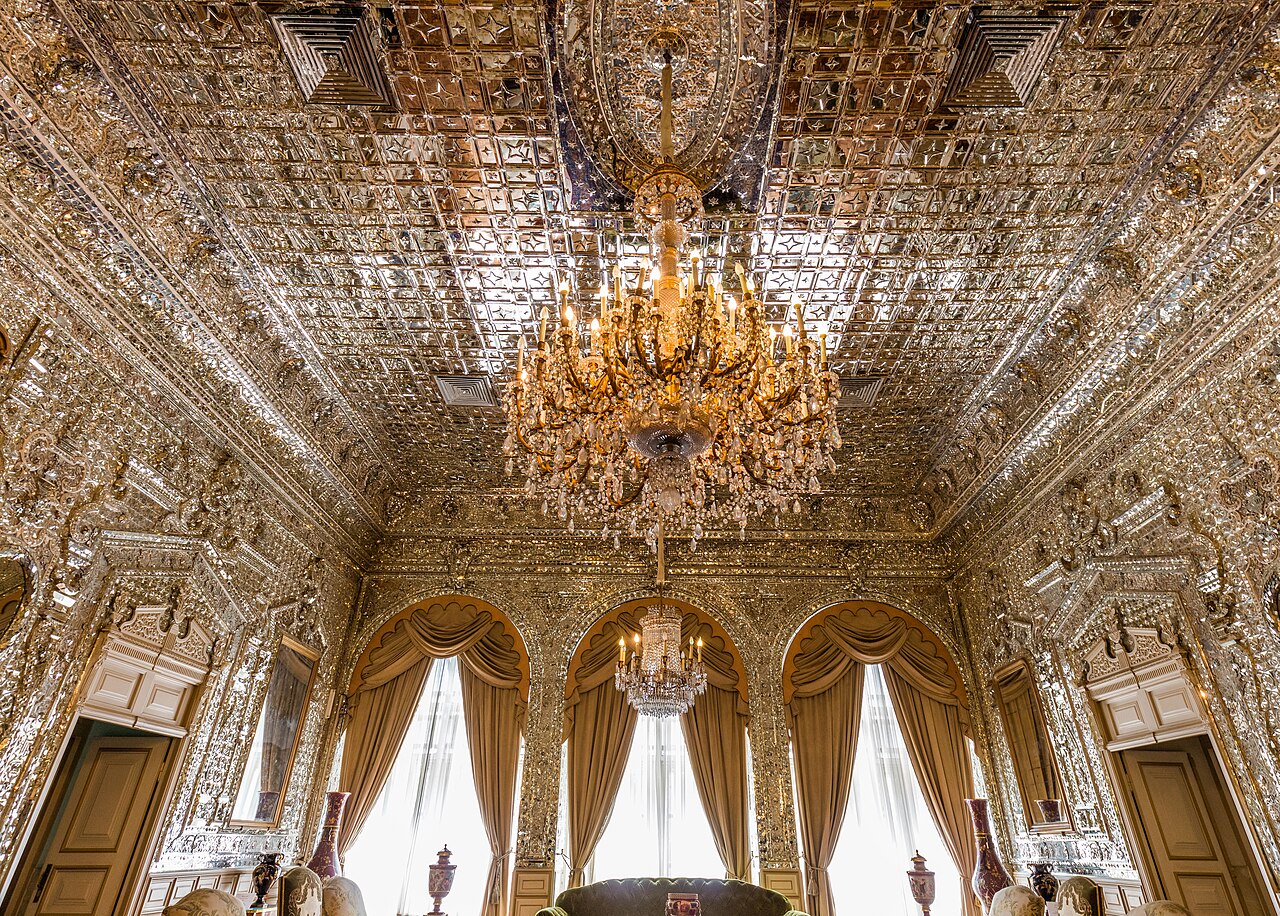
The history of mirrors in Iran is far longer than that of architectural mirrorwork. The available direct evidence, however, links the emergence of mirrorwork in architecture to the Safavid period. Current research does not establish its first site of execution with certainty. A possible early example in Shah Tahmasp’s divan-khaneh in Qazvin has been proposed, while its documented expansion is associated with the Safavid palaces and pavilions of Isfahan. During the Qajar period, mirrorwork developed in both the range of its applications and the diversity of its techniques, appearing in palaces, elite residences, gardens, and religious buildings.
This variety of settings matters. Mirrorwork in a palace hall, the reception room of a house, a garden pavilion, or a place of pilgrimage does not necessarily produce the same meaning. The patron, the building’s use, the composition of motifs and inscriptions, the relationship to light, and the spatial organisation of each example all contribute to its meaning. Mirrorwork’s presence in religious buildings forms an important part of its history, but that use cannot become the essential definition of the entire craft—just as the use of brick, plaster, tile, wood, or glass in a mosque does not make those materials and techniques inherently religious.
Nor does the Iranian origin of mirrorwork need to be established by claiming that the craft itself is pre-Islamic. The known historical form of architectural mirrorwork emerged in Safavid Iran. The critique of the label “Islamic art” here is not based on mirrorwork’s chronological precedence over Islam; it rests on the distinction between a historical context and the identity of a craft tradition. The fact that its earliest documented examples are Safavid, or that most of its patrons and artisans were Muslim, does not mean that “Islamic” is the most precise or sufficient name for its technique, geography, and history.
Mirrorwork is not the product of a single exhibition or an individual act. Its knowledge accumulated across generations through the work of master artisans: in methods of cutting and arranging fragments; the understanding of plaster and surface; the geometry of patterns; adaptation to architecture; judgement about light and reflection; and the practical transmission of skill. A contemporary artwork may alter this knowledge, extend it, or even position itself against it. But drawing on that knowledge without naming its historical trajectory renders the work’s relationship to its own source of knowledge invisible.
When a General Category Replaces History
Naming is not merely a choice of words. Names determine how a work is recorded in archives, the terms through which it can be found by search engines, the works beside which it is placed in museums, the history written to explain it, and the people recognised as bearers of its knowledge. If Iranian mirrorwork consistently appears only under the heading “Islamic art,” audiences may come to read light, geometry, or the fragmentation of the surface as direct signs of Islamic spirituality, without learning anything of its history in palaces, houses, and gardens, the artisans who made it, or its technical transformations.
In this process, a particular use or interpretation can replace an entire history. Light is reduced to “spiritual illumination,” geometry is immediately attributed to mystical unity, and reflection becomes a religious metaphor. Such interpretations may be valid for a particular work, building, or commission, but without evidence they cannot be treated as the fixed essence of mirrorwork. Its capacity lies precisely in its adaptability: it can generate different meanings and experiences in different situations.
For this reason, identifying Iran alongside an artist’s nationality is not enough. “Iranian artist” and “Iranian craft” convey two different kinds of information. The first refers to the identity or nationality of an individual; the second names the history of a body of material knowledge and the community through which it has been transmitted. An Iranian artist may work with a technique originating elsewhere, just as a non-Iranian artist may learn Iranian mirrorwork. What determines the origin of a technique is not the nationality of its present-day practitioner, but the history of its formation, development, and transmission.
From the Destruction of a Building to the Erasure of a Name
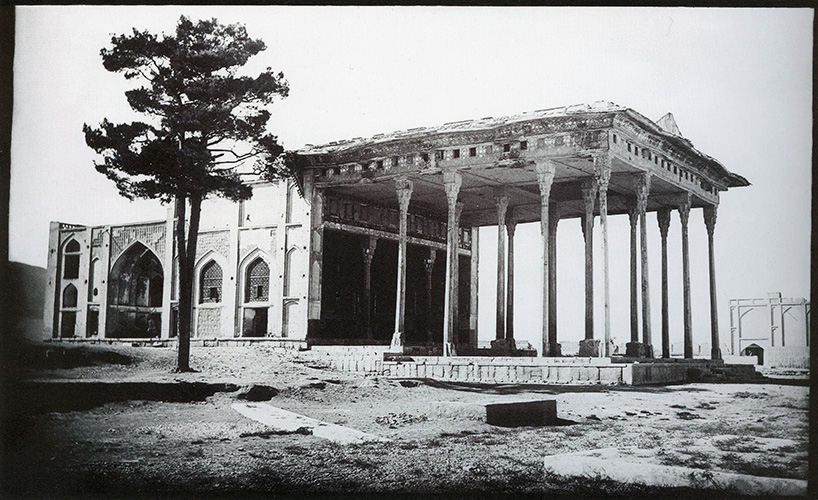
Ayeneh Khaneh in Isfahan, a Safavid building on the bank of the Zayandeh Rud, no longer exists. During his visit to Isfahan, Hajj Sayyah Mahallati saw Ayeneh Khaneh and Haft Dast “on the verge of destruction.” These buildings disappeared during the rule of Zell-e Soltan, and an important part of what we can now imagine of Ayeneh Khaneh depends on the surviving historical photographs.